Thursday, 21 November 2013

CHILDBIRTH IN HISTORY - continued


In the sixteenth century more attention was beginning to be given to the plight of women in labour and especially the care of the unborn child. One of the pioneers in this area of study was Ambroise Paré of France, who went to Paris in 1529, aged 19, having been a barber's apprentice. He received his early surgical training as a dresser at the Hotel Dieu. This institution was typical of the existing hospitals at that time, It was said to have been founded between 641 and 649, by Saint Landry, Bishop of Paris; the first mention of it in records being in 829, and was described by Tenon in his memoirs of the hospitals of Paris. In the Hotel Dieu there were 1,200 beds, of which 486 were for single patients; from three to six patients occupied each of the remaining beds, which were five feet wide. The large halls, unlighted and unventilated, held 800 or more patients crowded together and often lying about on heaps of straw which were in a vile condition.


Max Nordau said of the hospital: "In one bed of moderate width lay four, five, or six persons beside each other, the feet of one to the head of another; children beside grey-haired old men; indeed, incredible but true, men and women intermingled together. In the same bed lay individuals affected with infectious diseases beside others only slightly unwell; on the same couch, body against body, a woman groaned in the pangs of labour, a nursing infant writhed in convulsions, a typhus patient burned in the delirium of fever, a consumptive coughed his hollow cough, and a victim of some disease of the skin tore with furious nails his infernally itching integument........The patients often lacked the greatest necessities. The most miserable food was doled out to them in insufficient quantities and at irregular intervals. The nuns were in the habit of feeding with confectionary those patients who seemed to them pious enough, or at least those who reeled off their rosaries with sufficient zeal, but the body exhausted by disease required not sweets, but cried for meat and wine. Such food, however, the sick never received in profusion, save when it was brought to them by the wealthy citizens from the city. For this purpose the doors of the hospital stood open day and night. Anyone could enter; anyone bring whatever he wished; and while the sick on one day might be starved, on another day they might very likely get immoderately drunk and kill themselves by overloading their stomachs. The whole building fairly swarmed with the most horrible vermin, and the air of a morning was so vile in the sick wards that the attendants did not venture to enter them without a sponge saturated with vinegar held before their faces. The bodies of the dead ordinarily lay twenty-four hours, and often longer, upon the deathbed before they were removed, and the sick during this time were compelled to share the bed with the rigid corpse, which in this infernal atmosphere soon began to stink, and over which the green carrion- flies swarmed....."


In this hospital there were beds for children; in fact, eight such beds which accommodated a total of 200 infants and young children. About one-fifth of the patients in the hospital died and recovery from surgical operations was rare.


                                                           A ROOM IN THE HOTEL DIEU


From a woodcut of the sixteenth century. The beds shown were intended for two patients, but frequently five or six, regardless of sex or disease, were crowded into each one. Less fortunate patients found refuge on heaps of straw in the dark hall-ways. This hospital was indescribably filthy, as were all others at this period.


HOSPITAL PATIENT IN BED WITH A CORPSE

                                                             AN ETCHING BY DAUMIER


The following description of a hospital accommodating 549 patients in Lyons in 1619,  outlines the attention given to surgery: "There was only one medical man whose duty it was to look after the surgical cases; he resided outside of the building. When this surgeon required assistance in the dressing of wounds or in performing surgical operations, he was authorised to make use of the 'apothecary boy'. The stock of surgical instruments possessed by the hospital consisted of just five, which included a trephine for opening the skull and a mouth plug for keeping the jaws separated."

 After three years of training in the Hotel Dieu, Paré became an army surgeon and after pioneering development of procedures, particular to the wounds of soldiers, he went on to concentrate on the care of the unborn child.


Podalic version, as described by Paré, was to be used in those cases where the child was not in the normal position to be born. It required inserting the hand into the uterus, grasping one or both feet (hence podalic - pod - foot ) of the unborn child, and turning it (i.e. version - the manual turning of a foetus in the womb to make delivery easier) into such a position that it could be born. The child was usually pulled out at the same time.

Prior to the development of this procedure, cases of the child being in the wrong position to be born were usually fatal for both mother and child. The only reason for calling in the physician or barber was to, possibly, save the mother's life at the sacrifice of that of the child, by killing the child and removing it with instruments that the pagan priests and later the physicians devised for this purpose.

There was one alternative procedure to podalic version which saved the life of the child at the expense of the mother - a procedure advocated by the Roman Church - Caesarean section. This operation consisted in removing the child through a cut made in front of the abdomen. The name Caesarean attached to it has tended to suggest that Julius Caesar was born by this means, but there is no evidence that at the time of his birth this operation was performed on a living woman, but only after death as a religious measure; his mother, Julia lived many years after his birth as is proved by his letters to her. The operation probably obtained its name from the fact that the Roman law required this procedure in case of the mother's death. In 715 BC the king, Numa Pompilius, codified the Roman law, and in the lex regia as it was called, it was ordered that the child should be removed from every woman who died when far advanced in pregnancy, even in cases where there was no chance of survival for the child, so that the mother and child might be buried separately. The lex regia became lex Cesare under the rule of the emperors, and the operation became known as the Caesarean operation, or section.


A CAESAREAN OPERATION IN THE SEVENTEENTH CENTURY


Very few such operations were performed at that time, for there was no anesthesia, asepsis, or adequate means of controlling haemorrhage. The woodcut shown here appeared in the works of Johann Schultes, a surgeon of the seventeenth century.

Ambroise Paré opposed Caesarean section, indeed, few such operations had been performed on living women at that time, and Paré's opinion influenced the advancement of the procedure for more than a century. Even a few centuries later it remained an operation of last resort because of the suffering and high mortality involved. Paré's alternative - podalic version, however, was not applicable to women with abnormally small pelvises, but Paré believed ( as had the Greeks ) that the pelvis separated in the middle and opened out during the birth of the child and this was the cause of the pains of childbirth. Even so podalic version was at the time a considerable advance in the saving of the lives of infants and the suffering of women; it laid the foundation for the medical discipline - obstetrics.

In Paré's time a school for midwives was opened at the Hotel Dieu in Paris. The women who graduated from the school of midwifery were rather superior to the uneducated females who had formerly provided 'assistance' to women in labour. Louise Bourgeois, 'sworn midwife' of the city of Paris, was among the first of the graduates; in 1601 she officiated at the birth of Dauphin (later Louis X111), and afterward at the birth of the other children of Marie de' Medici.


The next step was the participation of the physician himself in midwifery. Boucher was called in to attend La Vallière, mistress of Louis X1V, and the king is said to have confirmed his interest in this reinstatement of male midwifery by watching the procedure whilst hiding behind some curtains. In 1670 Julian Clement attended Madame de Montespan at the birth of the Duc de Main, and in 1682 he delivered the Dauphin. Clement received the title of accoucheur, to replace the derisory name of man midwife, or midman.

Soon male midwifery became the fashion among the ladies of the court.


Even though Paré had furthered the development of obstetrics and Clement earned a dignified name - accoucheur - for the profession, the attempts of the physicians to practice obstetrics were met with extreme prudery, except in the case of attending royalty. Sometimes he was forced to tie one end of a sheet to his neck, and the other end to his patient's neck. Both could see above the cover, but the physician could not see beneath it and made his manipulations blindly.


Insulting names were often used to undermine physicians who practiced obstetrics. When Dr. William Smellie, in the eighteenth century, established a school in London for teaching midwifery, he was christened by his competitor, Mrs. Nihell, the Hay Market midwife, " a great-horse-godmother of a he -midwife." Smellie is remembered in medical history because he made and published the first exact measurements of the pelvis.


As late as the eighteen-forties John Stevens, of London, denounced and exposed in his pamphlets ' the dangers and immorality ' of employing ' men in midwifery '. he dedicated his efforts to the Society for the Suppression of Vice.


  The extent of  prudery - a physician operating under the sheets


For thirteen centuries the physicians of Europe were not allowed to attend normal cases of delivery, but in the seventeenth century they began to participate to some extent, but they were met with extreme prudery and were often forced to carry out their manipulations blindly. A woodcut from the works of a Dutch physician, Samuel Janson, 1681


Three Kids Gripped By Evil By Polly Mullaney     
Amazon Kindle, Amazon paperback


Wednesday, 20 November 2013

CHILDBIRTH PRACTICES IN HISTORY

Child-bearing, always accepted as a natural process, tended to be treated with dispassion but also brutality. At the height of early civilisations – Egyptian then the Greek and Roman civilisations - methods of caring for the child-bearing woman were well developed. However, with the decline of the Greek and Roman civilisations the care of women deteriorated and the practices developed by the Greeks were not heeded in Europe. Procedures in childbirth did not recover until the sixteenth or seventeenth century.


METHODS OF HASTENING LABOUR


Among the Greeks at the time of Hippocrates the methods of assisting the woman in labour were often brutal. The woman was sometimes repeatedly lifted and dropped on a couch.


This method of tying the woman to a couch, which was then turned on end and pounded against a bundle of faggots on the ground, was finally abandoned by the Greek physicians amongst other aggressive procedures


Accordingly, the treatment of child-bearing women was considerably neglectful. During medieval times the mortality rate for both mother and child rose to a uniquely high level due to indifference to the suffering of women and to the low regard for the value of life.
This period was characterised by the fervour of religion and the squalor of daily life, consequently nothing was done to overcome the enormous mortality of mother and child at birth. Typical of this age were the attempts to form intrauterine baptismal tubes, by which the child, locked by some difficulty in the womb, could be baptized and its soul saved before mother and child were left to die.


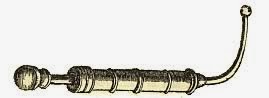
                                                                BAPTISMAL SYRINGE


For applying this rite to infants before birth in cases of difficult labour. This particular syringe was designed and described by Mauriceau in the seventeenth century, and Laurence Sterne, in Tristram Shandy, quotes the original description in full. This syringe was the 'squirt' of his 'Dr. Slop'. In some designs the opening of the nozzle was made in the form of a cross to add sanctity to its use.


AN OBSTETRICAL CHAIR
The obstetrical chair upon which women sat during childbirth is mentioned in the Old Testament. The Greeks occasionally used a special bed or couch for this purpose, but the chair continued in general use until the 17th century and was often used as late as the 19th century. This particular design was recommended by Eucharius Roslin in 1513. 


Mauriceau of France in the seventeenth century started the innovation of using a bed for childbirth.


                                            OBSTETRICAL CHAIR IN USE

 A reproduction of a sixteenth-century woodcut appearing in The Garden of Roses for Pregnant Women, by Roslin.


In Medieval times religion took over the practices of the midwives, thus the Dominican monk, Albert Magnus (Albert von Bollstadt 1193-1280 ), wrote a book for the guidance of midwives, and the Church councils passed edicts on their practices. These instructions and edicts were not, however, for the better care of the child-bearing woman, for the relief of her suffering or the prevention of her death. They were designed to save the child's life for a sufficient time to allow it to be baptized. The Council of Cologne in 1280 decreed that on the sudden death of a woman in labour her mouth was to be kept open with a gag so that her child would not suffocate while it was being removed by operation.

By the beginning of the Renaissance practices improved little. Even in a normal delivery the woman often died from infection or eclampsia. In difficult labour she was left to die or butchered to death if her midwife was so inclined, or a rogue 'surgeon' could be found to assist the slaughter. As a rule the matter was left entirely in the hands of the midwife, and in 1580 a law was passed in Germany to prevent shepherds and herdsmen from attending obstetrical cases. An indication of the advancement in care of the childbearing woman and the appalling conditions it had advanced from.


                                                      FIFTEENTH-CENTURY NURSE AND CHILD

From 'Versehung des Liebs'. Accompanying this picture were the following directions for selecting a nurse ( translation is from Ruhrah, Pediatrics of the Past) .

"At times it happens that from various causes the Mother cannot suckle the child herself. In such a case one must choose a nurse for the child. Her qualifications should be as follows. 

The nurse should be of shapely stature, not too young and not too old. She must at all times be free from illness of eyes or body. Moreover, her nature must be such that there is no defect in her body.  Mark also, that she must be neither too slim, nor too plump. If there should be any defect in her, the child would incline towards it. 
She must have a good character, modest, chaste and clean. 
Her food should be in conformity with the following directions, so that the milk may remain fully nourishing. I prescribe her to eat white bread and good meat, also rice and lettuce every day. Almonds as well as hazel nuts she should not do without. Her beverage must be pure wine; and in moderation must be used in bathing. Nor must she do much labour. 
In case her milk should give out, she must not forget to eat peas frequently and in quantity, also beans, and in addition gruel which should be boiled in milk beforehand. She must also rest and sleep a good deal so that the child may thrive on the milk. Moreover, she must carefully avoid onions and garlic; as well as any bitter or sour food and any dish containing pepper. 
She must eat no over-salted food, nor anything prepared with vinegar.
Love's intercourse she must also avoid or go in for it very moderately. For in case she should become pregnant, her milk would be harmful to the child. In order that the child may not be harmed in such a case, one must wean it from the milk."


This scenario was for the privileged few because this was a time when public, domestic and personal hygiene was appalling. The walled cities were for the most part densely crowded and had no drainage. Filth accumulated in the unpaved streets. The houses were described by Erasmus as containing open cesspools, their floors were strewn with refuse, and in them was a pestilence of flies and vermin. They were indeed sinks of filth and infection.
Ancient Rome had paved streets, Paris had none until the eleventh century and London had its first paved streets in the sixteenth century. In that same century Frankfurt-on- the-Main began requiring each house to have a ‘privy’ and ordered that the pigpens of the city should be cleaned.


Eucharius Roslin, of Worms, in response to the wishes of Catherine, the Duchess of Brunswick, wrote a manual from which the ignorant and careless old women who made up the midwives might learn to conduct their work in a safer and more efficient manner. This book was published in Worms in 1513 and contained nothing that was new, but did bring to light the work of the Greeks; it was, however, marked with the superstition of medieval medicine, and with the horrible doctrine of medieval surgical midwifery.

The prejudices which at that time existed in the minds of people, particularly in cities, against the slightest participation of males in the practice of midwifery, were so great that Roslin, who had probably never seen a child born, may have felt something of the humour of his position, for the title of his book was The Garden of Roses for Pregnant Women and Midwives. The book, nevertheless, accomplished much good; it was extensively plagiarised by later authors and was translated into Latin, French, Dutch, and English - in which the title became The Byrthe of Mankynde.


                                  EUCHARIUS ROSLIN PRESENTING HIS BOOK TO THE DUCHESS OF BRUNSWICK


A PAGE FROM 'THE BYRTHE OF MANKYNDE' - WILLIAM RAYNALDE'S ENGLISH TRANSLATION OF ROSLIN'S BOOK ON MIDWIFERY


The exclusion of men from the study of child-bearing women tended to reach fanatical extremes. In 1522, Dr Wertt, of Hamburg wore the dress of a woman to attend and study a case of labour; he was punished for this lack of reverence by being burned to death.


Three Kids Gripped By Evil By Polly Mullaney     
Amazon Kindle, Amazon paperback


Saturday, 16 November 2013

Ruthin Castle To The 20th Century


From: A Journey into North Wales in the Year 1774
Boswell and Johnston

August 4th
Ruthin Castle is still a very noble ruin; all the walls still remain, so that a compleat platform, and elevations, not very imperfect, may be taken. It encloses a square of about thirty yards. The middle space was always open.
The wall is, I believe, about thirty feet high, very thick, flanked with six round towers, each about eighteen feet, or less, in diameter. Only one tower had a chimney, so that there was commodity of living. It was only a place of strength. The garrison had, perhaps, tents in the area.

From: The History of Ruthin Castle by Reginald de Hereford:

' The last male heir of Chirk, Richard Myddelton of Llysfasi, died intestate in 1796 leaving three daughters: Charlotte, Maria and Harriet. The Court of Chancery awarded the Chirk Castle estate to Charlotte; the Ruthin Castle estate went to Maria; and Harriet received the Dyffryn Ceiriog estate.
'Maria decided to come and live at Ruthin in 1826. In 1798 she married Frederick West, 3rd son of the 8th Baron West and 2nd Earl de la Warr (his first marriage had been with Charlotte Mitchell of Culham Court, Berkshire. Died 1795). Maria died in 1843. There was an only son surviving - Frederick Richard (b. 1799 and d. 1862). He married twice:

1. Lady Georgina Stanhope, daughter of William Philip, 5th Earl of Chesterfield, in 1820. She died without issue in 1824.

2. Theresa, only daughter of Capt. John Whitby, R.N., on 11th September, 1837. She died 18th September, 1886.

Ruthin Castle was no more a stronghold after the wreck of the Civil War (1642 - 49). Its venerable stones were carted off and neglect remained until a Myddelton daughter took interest in her inheritance. The home which she built in 1826 was a castellated, two-storeyed, double- block of grey limestone on the south-east corner of the ancient site; the two portions were linked together with a slender covered bridge. . The interior was in keeping with the classicism of the 18th century. At the rear, amongst the domestic quarters, arose a four-dialled clock-tower.'


 Ruthin Castle, 1830.

Ruthin Castle was ordered to be demolished after its surrender to General Mytton in 1646, and it was not until the time of Maria Myddlelton that the new castle was built. She married Frederick West in 1798, and decided in 1826 to make Ruthin her residence. The 1826 building was castellated, two-storeyed double-block of grey limestone on the south-east corner of the site of the original castle. In the period 1849 - 52 the Wests demolished part of their house and erected the present red sandstone building - a rectangular block of three storeys with an octagonal tower on the south-west corner overlooking a broad terrace. The style is fifteenth-century perpendicular, and the architect was Henry Clutton. prominent in the gothic revival of the nineteenth century.


THE CORNWALLIS-WEST ERA

'The marriage of Frederick Richard West with Theresa Whitby brought in a name which they treated with the utmost respect. Her father, Capt. John Whitby, R.N., had died a few months after the child was born. His close friend for many years, Admiral Cornwallis, made himself the guardian of the widow and her young daughter. At his death he bequeathed all his possessions to Theresa Whitby. The bequest included Newlands Manor, the home of his retirement, on the Hampshire coast within site of the sea, (the Solent).

'In 1849 - 52 the Myddelton-Wests demolished part of their house, and, on the same site, put up the present handsome pile of local red sandstone. It is a large, well-proportioned, rectangular block of three storeys with an octagonal tower on the South-west corner overlooking a broad terrace. The style is 15th century Perpendicular and was conceived with restraint in the fullness of the 19th century gothic revival by Henry Clutton. The mellow fabric is lighted with a series of fine bay, mullion, and oriel windows. Guests pass inside through an entrance flanked with carved Welsh dragons into an oak-paneled hall.

'It was during the period 1849 - 52 that Henry Clutton enclosed the immediate precincts with curtain walls complete with gate and lodge, of grey limestone with comices and castellations of red sandstone, looking towards the town. The gate is formed of a great arch in similar 15th century style above which is a small terrace. Prior to all this the Corwen Road had pursued its way under the castle walls from the decade which followed the Civil War. It turned right, over a bridge in the meadow, and across the deer-park to descend to a lower level at the farther end of Pwll Glas. Privacy having been gained, the Wests provided fresh land for a diversion which made a new and better Corwen Road.

‘Within the enclosed space gardens were laid out; trees were planted; and a most graceful vista created along the new carriage-way. In early spring the avenue appears to be wreathed in a mist of emerald green; in autumn the leaves of the majestic trees change to gold and russet and creating a scene of incomparable richness. It was at this time that Mrs. Theresa Whitby-West planted the fine elms along the new Corwen Road. At the same time a constant supply of pure water was laid from the spring at Y Galchog.'


Following extract from 'Handbook to Ruthin and Vicinity' by Lewis Jones - 1884

' The castle which remained in utter ruin for 180 years, was partly rebuilt in in 1826; and finally brought to its present state in the year 1852 by the late F.R.West, Esq., M.P. A great number of very interesting "relics of the past" and other "curiosities" are to be seen in the Armoury, and the grounds of this magnificent Castle are universally acknowledged to be "extremely beautiful." From whatever point it is viewed it commands a most picturesque appearance, - and from its tower is to be seen, on a clear day, the Vale of Clwyd at one glance, down to the sea, a distance of 20 miles - a landscape of such majesty and beauty is rarely to be seen and suggests:

"How sublime are her mountains, with verdure clad,
How lovely her valleys and dale;
Abounding in woodlands, in dingle, and dell,
Oh! what beauties combined in this vale !"

It is now the residence of its owner, Major W.C.West, lord Lieutenant of the county.


From The History of Ruthin Castle by Reginald de Hereford:

'Thrice-married George Cornwallis West shot himself in 1951, having been described as a rogue, an amourous fool, a victim of randy royalty and the Lilly Langtry set.

'Georges mother, Patsy, had the reputation of being the wickedest woman in Wales. His true father was widely believed to be Edward, Prince of Wales, who was also one of 200 identifiable lovers of George's first wife, Jennie - mother of Sir Winston Churchill, only a fortnight younger than his Ruthin step-father.

"At least no one could say we were dull or ordinary, " wrote George's sister Daisy. "Indeed the chief accusation against us was that we were too lively. King Edward V11, who loved us all, christened us the Wild West Show."

'Daisy left Ruthin for Silesia, where she became the Princess of Pless. her sister Shelagh settled down in Chester, as Duchess of Westminster, the first of the Duke's four wives.
'Having provided three generations of eminently respectable Members of Parliament for Denbigh, the Wests were shaked out of their Ruthin Ruritania by the arrival, in 1872, of the 16-year-old bride
Patsy, daughter of a Dublin clergyman.


                                                                         Patsy


'All three of her children were born before she was 21, and Colonel William Cornwallis West, 20 years her senior, soon lost control over his wife's beauty.'
"Patsy had been a ' professional beauty ' whose picture gazed out of shop windows along with Lilly Langtry, Ellen Terry and Jennie Jerome with other 'PBs;' she had an affair with the Prince of Wales", writes Margot Peters in the latest book to invade the bedrooms of the period.

"It was widely assumed that George was his child, and that by standing god-father, Albert Edward had acknowledged a closer relationship," adds Dr. Peters.


'Prince Edward turned up at Ruthin Castle in May 1899. So did Patsy's rival beauty, the former Jennie Jerome, widow of Lord Randolph Churchill who had died of syphilis.
'Three months later George and Jennie announced their engagement, and Jennie's son, Winston, denied it. George was 25 and Jennie, by then known as lady Randy, was 20 years older.
'They were married in 1900 at S. Paul's Church, Knightsbridge, the bride given away by the Duke of Marlborough. Winston was missing, as were George's parents - they had left Ruthin the day before, for a holiday in Ireland.

Eventually, in the early 20th century the Castle became a Private Hospital or Clinic. The following illustration is an advertisement for potential patients in 1941.


Three Kids Gripped By Evil By Polly Mullaney     
Amazon Kindle, Amazon paperback